 Call us on 01635 728081
 Email us at info@premier-homeimprovements.net
 Want us to call you? Request a Callback


What Is the Best Front Door for Security and Insulation?
Any door claiming enhanced security credentials should carry this accreditation. Composite doors almost universally meet this standard. Good-quality UPVC doors should also carry it, if a quote doesn’t mention it, ask.
Beyond the door material itself, the locking system is equally important. Multi-point locking, where the door locks at three or more points along the frame when you lift the handle, is now standard on any decent front door and is significantly harder to force than a single-point lock.
Your front door works harder than most people give it credit for.
It’s the first line of defence against intruders, one of the main points of heat loss in a typical home, and fairly or not, one of the first things people notice about a property. When it’s time to replace it, it’s worth understanding what actually makes a front door perform well.
Composite Doors - Security and Insulation Together
Composite doors are built from multiple materials, typically a solid timber or insulating foam core, sandwiched between layers of UPVC, GRP (glass reinforced plastic), and sometimes aluminium reinforcing. The result is a door that is:
- Harder to break through than a hollow or single-material door
- Better insulated — the foam core traps heat effectively
- Dimensionally stable — it doesn’t expand, contract, or warp with temperature changes
- Low maintenance — the GRP outer skin won’t crack, peel, or need repainting
For most homeowners looking for the best combination of security and thermal performance, a composite door is the strongest choice.
UPVC Doors - A Solid, Affordable Option
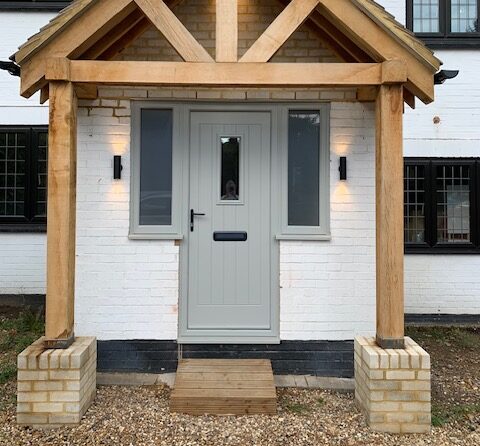
Quality UPVC front doors offer good security, particularly with multi-point locking and solid thermal performance.
They’re generally more affordable than composite and available in a wide range of colours and styles. The main consideration is rigidity: cheaper UPVC doors can flex slightly, which can affect both security performance and draught resistance over time.
Quality matters here as much as it does with windows.
Timber Doors
Solid hardwood front doors look exceptional and can offer good insulation and security when properly constructed and well-maintained.
The downsides are the ongoing maintenance requirement, timber needs treating regularly and the potential for warping if that maintenance lapses.
For period or listed properties, a well-made timber door is often the most appropriate choice on aesthetic and planning grounds. For most modern homes, composite or UPVC will offer better long-term practicality.
So, What's the Best Front Door?
If budget is the priority, a good-quality UPVC door with multi-point locking is a sound choice. For period or listed properties where planning requires it, a well-specified timber door is the right route.
Whatever you choose, the three things that matter most are: PAS 24 accreditation, multi-point locking, and quality installation. A good door fitted poorly will underperform.
Browse our full doors in Newbury to compare styles, materials and security ratings.
Get In touch
Contact us on 01635 728081 or complete our Online Enquiries Form